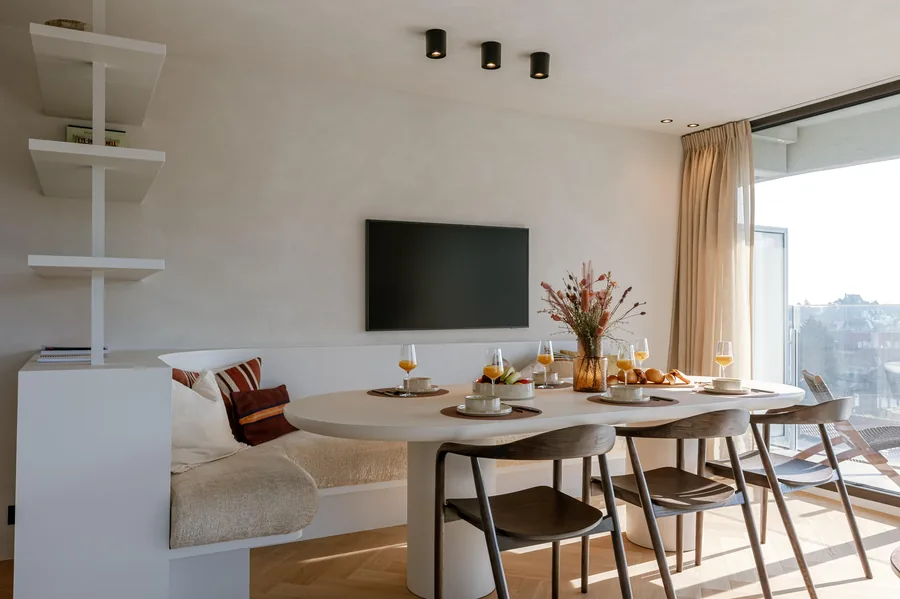
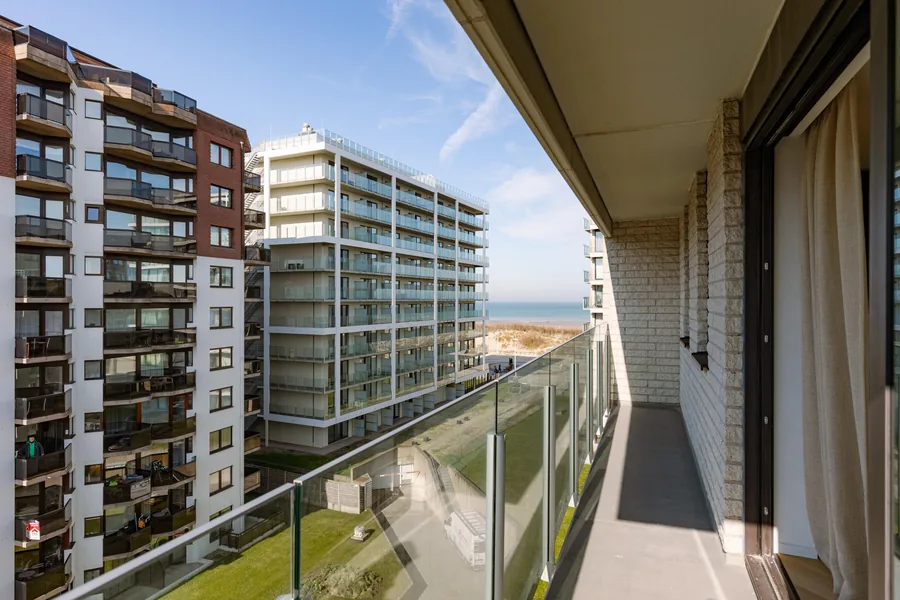
The Witte Burg is, like so many corners of the Belgian coast, above all a street. An asphalt line running out into dune grass, bordering a nature reserve. Until a few years ago nothing stood out here; today there is Villa Picasso, a rectangular volume in concrete with a wooden inner core, that manages to avoid all the theatrical gestures of 1990s architecture.
The property was delivered in 2016. Not our drawing, not our build — but our scenario. When we took it on in 2023, we had a question: what do you do with a house that is already finished? The answer turned out to be, in fact, not architectural at all. It became interior architecture — and art.
The skeleton
The villa is a simple geometric composition. A rectangular footprint about thirty metres long, with a height difference between the two living zones. The bedrooms upstairs, the living area downstairs with a double-height dining room. Materials stay limited: polished concrete for the exterior walls, oiled walnut for the floors, glass for everything that looks outward.
The choice for walnut over oak is no accident. Walnut is warmer, deeper, and has that characteristic chocolate hue that only grows more beautiful over time. It breaks up the austere white walls and cool concrete — and it is no passing trend; this plank will still be there in twenty years.
What we added
For every property we decorate, we start with two questions: does this piece belong here, and does it grow more beautiful with time? That brought us to a number of icons.
The first was an original Rietveld Red & Blue — a chair from 1918, contemporary with Picasso and from the same European modern tradition. It stands alone in a corner of the main living room, not to sit in but to look at. Opposite: a De Sede Terrazza (DS-1025), that wavy cognac-leather modular sofa from 1972 by Ubald Klug, that takes you back to interiors out of Tom Ford films, yet surprisingly practical for families.
A good house is not a collection of beautiful objects. It is a space in which every object supports the others.
In the second living room, a floor up, we went in a different direction: a curved bouclé sofa in cream, a Noguchi-style glass table, a sheepskin rug, and above the gas fireplace — which itself obeys the geometry of the property — two Picasso-style sketches in black and white. No reproductions, but hommages.
The art
We have spoken about the art before. Throughout the house hang works that explicitly or subtly cite the namesake: black-and-white abstract sketches that reference his linework, a striking cherry-blossom piece above the stairs that reconciles European with Asian, smaller geometric compositions in the corridor.
The choice isn't obvious. Picasso's own work is either unaffordable, or so well known it shrivels into decoration. Hommage art by contemporary Belgian artists — often in limited editions — gives the property the right atmosphere without the cliché line: "we have a Picasso on the wall."
What makes a house a home
Architecture, as someone once said, is frozen music. But music is only useful when played. A house, even a beautifully built one, only becomes a home once something happens: conversations, cooking, children running down the stairs, a glass on the terrace. Our task, as we see it, is to provide the frame in which all of that becomes self-evident.
That is why Villa Picasso is not a show home. It is a dwelling, with scratches and traces of use and the kind of patina that only comes from inhabitation. We rather like that. It is how it should be.